Why Google Rankings Fluctuate and When to Worry
Why do Google rankings fluctuate?
Rankings move every day because Google re-crawls pages, tests results, updates its systems and reacts to competitors. Small daily moves are normal. Worry only when a drop is large, lasts more than a week or two, and affects many keywords.
Quick verdict: Small daily moves are normal. Act only on drops that are large, last over a week and hit many keywords.
Price tier: Free
Run a free checkNormal reasons for movement
Rankings move daily for normal reasons. Competitors publish and update pages, Google re-crawls and re-indexes content, runs ranking tests, rewards fresh pages on trending topics, and serves location-specific results, so a check from another place often shows a different order.
- Competitors change: new pages are published and old ones updated.
- Re-crawling and re-indexing: when Google re-evaluates your page or a competitor's, positions shift.
- Testing: Google regularly experiments with result order and features.
- Freshness: for news and trending topics, newer pages can rise quickly then settle.
- Personalization and location: a check from a different place or device can show a different result. See location and device effects.
Bigger causes
Bigger ranking moves have four common causes: Google core updates, technical problems such as accidental noindex tags or broken redirects, site changes like migrations or removed content, and intent shifts where Google decides searchers want a different type of page.
- Algorithm updates: Google announces core updates; rankings can move noticeably during the rollout and settle afterwards.
- Technical problems: accidental noindex tags, blocked pages in robots.txt, broken redirects or server errors.
- Site changes: migrations, URL changes, removed content or changed internal links.
- Intent shifts: Google may decide searchers want a different type of page, such as a list instead of a product page.
Noise or a real drop?
Separate noise from a real drop by reading several weeks of data. A keyword bouncing between 6 and 9 is noise. A keyword that falls from 5 to 25 and stays there is a real change, especially when many pages drop together.
Look at the trend over several weeks rather than a single day. A keyword that moved from 5 to 25 and stayed there is a real change.
Also check whether the drop is isolated or affects many pages at once; site-wide drops usually point to technical issues or an update.
What to do
When a real drop appears, confirm it with a clean live check in the right country, review Search Console for indexing errors and manual actions, compare your page with the pages that now outrank it, and improve the content for search intent.
- Confirm with a clean live check in the right country.
- Check Search Console for indexing errors and manual actions.
- Compare your page with the pages that now outrank you.
- Improve the content for the searcher's intent rather than reacting to every daily move.
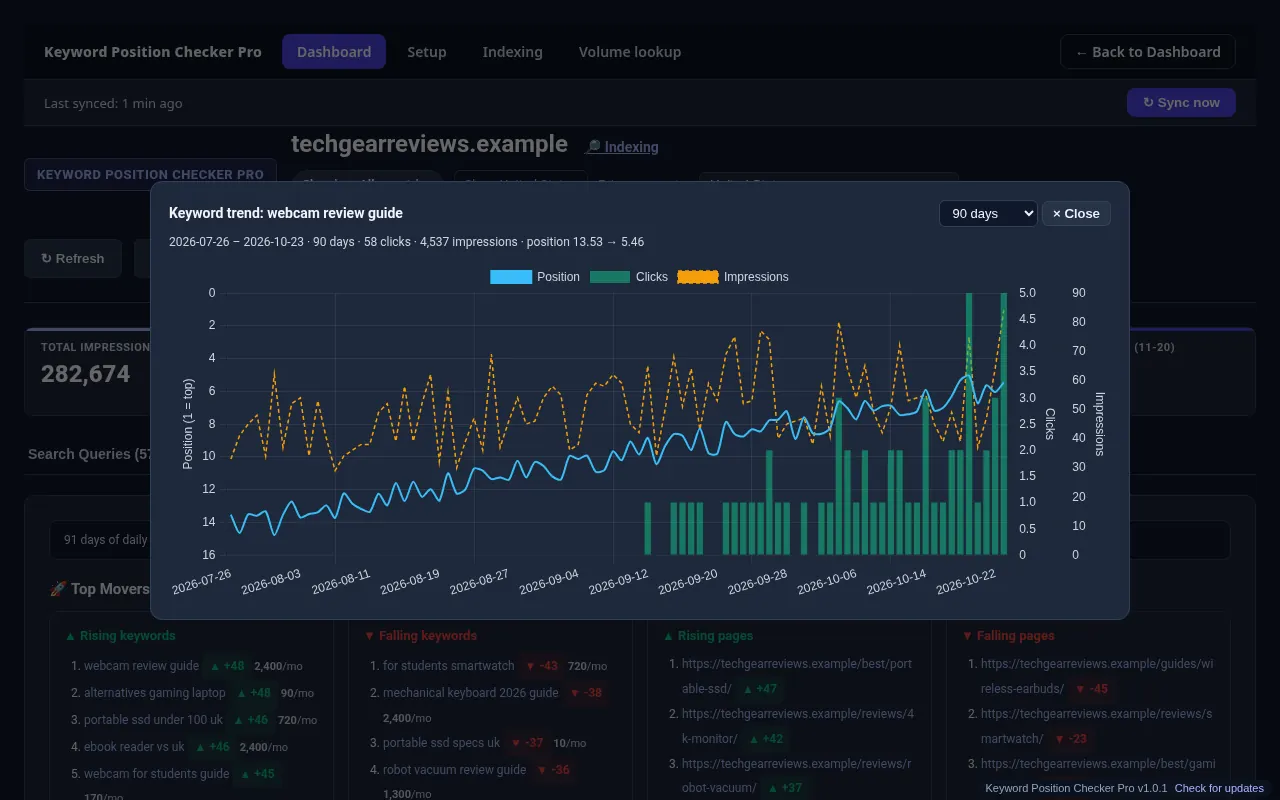
Tracking keyword momentum over time makes this much easier, because you see direction instead of daily noise.
The momentum chart shows direction over time.
Common mistakes
Three mistakes turn normal ranking noise into wasted work: rewriting a page after one bad day, comparing checks from different locations or devices, and changing many pages during a core update before rankings settle and the real pattern becomes visible.
- Rewriting a page after a single daily drop.
- Comparing checks from different places or devices.
- Changing many pages mid-update, before results settle.
Check one keyword now, or track all of them.
Run a free check with the Keyword Position Checker (3 per day, no sign-up). To follow every keyword on every site each day, see Keyword Position Checker & Tracker Pro for Windows.
Early bird: $299 with code EARLYBIRD for the first 50 buyers (regular price $499). One-time payment, 3 PCs.